Showing posts with label Geek-Out. Show all posts

Sunday, August 15, 2010

Entranced!


I am describing my mind and it's fixation with the WikiLeaks/Pfc Manning/Wired Magazine (via Kevin Poulson)/Adrian Lamo/Icelandic Law thing. I am like a person watching a car wreck. I cannot look away. I have not made up my mind on this but I am very intrigued. WikiLeaks may be a criminal enterprise, a heroic counterpoint to secrecy and big brother or we may be watching the evolution of journalism before our very eyes. 

Here is the story so far: Mr. Assange has assisted in the crafting of legislation that was recently passed in Iceland and which subsequently creates a "free press haven" which protects him (and other journalists) from search and seizure and incarceration. He stores his data there and elsewhere where data protection laws exists. He is mirrored by hundreds of other sites and distributes his data globally. Then he leaks 92,000 US military files from Afghanistan (Actually, 77,000 - he keeps some in reserve for Insurance). He shows the horrors of war while continuing to uncover the underhanded practices of individuals, groups, businesses, religions, governments. Private Manning appears to be the leaker and was turned in by Adrian Lamo, the barefoot hacker. The story breaks on the Wired Magazine "Threat Level" blog run by hacker Kevin Poulsen. We learn that Private Manning has a pretty high security clearance and is love with a drag queen from Cambridge, Mass. We have human rights groups joining the military in asking WikiLeaks to edit the documents to protect the people assisting the US Army in Afghanistan. Lastly, we now learn of a potential war within the WikiLeaks "organization" and a potential CyberWar with the US military. 

He described the original goal of Wikileaks and how it evolved and adapted over time recently at a Berkeley Graduate School of Journalism symposium. This symposium took place just prior to the passage of the law and thus prior to releasing the documents. 

This is a story revolves around hackers. There are hackers at the center, hackers at the news outlets, hackers whistle-blowing on the hacker whistle-blower. This story is crawling with them.

Rather than debate the moral and ethical issues or try and talk about the impact on the newly changing journalistic world or the case details I would like to discuss what the heck happened to those pesky kids inspired by the movie WarGames and Captain Crunch.

In the past 20 years or so hackers have been portrayed by the media consciousness as teenage nerds disillusioned with their place in the world. Kids who get bullied in school and fight back by hacking into NORAD or AT&T or whatever. They have been shown as dweebs and techno punks. I never thought that any of these images were very accurate. Stories about real hackers never seemed to jibe with the images of Hollywood or the mainstream news.

I have been to a few hacker conventions and know a few hackers myself (let us not have a semantic debate about the term - Hacker - that fight was lost awhile back in 1983 if not before. It has many meanings but ask someone on the street in Des Moines or Tulsa and they have a very particular image in mind. In this I omit those folks who steal grandmas credit cards or push child porn and their ilk).  The folks I have met and know are crafty and witty. They spurn convention. They want to know how things work without having someone do the work for them. They love pranks and hate injustice. Some are very vain and cruel. They want information to be free to all. Others are gregarious and kind. All of them have one thing on common, they are all very smart. You have to be smart in a subculture where "what you know" and "what you can do" are the means to establish your status. 

I do not think that the general hacker populace cares one bit how they are portrayed in the media regardless in the past 10 years or so many of them grew up. Those 13 year old kids who in 1983 watched David Lightman hack into WOPR are now 40 and they are doing things.

Originally, they started out in a predictable way. They continued to hack into systems they did not like. They started network sit-ins. They defaced the sites of organizations they didn't like. Then they really evolved.

They started coordinating efforts of anti-WTO protesters in Seattle in 2000 and protesters at the Democratic National convention in Denver in 2008. All groups were open as targets as long as the hackers thought they were making news or changing the public opinion.

Assange and his crew wanted to change the way the media and "just folks" got their information. He wanted to link up all these bloggers with too much time on their hands with original source material and let them get the news unfiltered and then voice their opinions. well, It didn't work out quite how he planned but is doing something. What this something is we will see in the coming months.

The Hacker ethos has finally hit the mainstream. Google (net neutrality issues aside) has sponsored with Yahoo, Microsoft and others some "Random Hacks of Charity" and defied the work of the Chinese government to expose opposition party chinese nationals. Bill Gates wants to make a difference with his charities and has convinced many billionaires to follow his lead. 

J0hnnyhax, otherwise known as Johnny Long, and some friends went to Africa and started Hackers for Charity with the goal of, "proving that hackers have amazing skills that can transform charitable organizations. We’re about stepping into the gap to feed and educate the world’s most vulnerable citizens. We are virtual, geographically diverse and different." He has done amazing work in Uganda setting up labs and user groups, computer education and training. Recently he has been despondent, however. His blog posts the following, 
"HFC has done little relative to our collective capability.
We can throw an 802.11 signal a world-record distance of 275km using junk hardware. We can rootkit Android before it’s released, hack GSM, hijack global DNS, pick every lock on the planet, beat international news agencies to the punch, and weed our way into previously untrodden shadows of the digital world. There is amazing skill in our community. We build robots just because we can, and tweak just about every technology on the planet to unbelievable ends. We are motivated and brilliant. We are self-organizing and ultra-productive when assaulting “impossible” projects. We break, bend, and then re-create the rules. But can we really, honestly do some good in the world? My answer used to be a resounding “YES!” Now, my answer is a much-too-passive “Maybe”.
Yes, with me and my family on the ground here in Uganda, some positive things have happened (http://www.hfc-uganda.org). But is that work reflective of the power of our community? Hardly."

The rent for HFC just doubled in Uganda and Johnny despairs. 

The world is changing. Hackers are growing up. They are attempting to do what previous of generations of folks have tried time after time. They want the world to be fair. They want to contribute. they want to make a difference. It is a hard, long, twisting road and is uphill both ways. Giving up or giving in would be easy and just chugging along in the normal pay-earning life with all our normal problems of home, job, family and personal life seem to be enough to consume all our time. Where will this go?

Will HFC continue? Will Assange get arrested? Will Google divide the Internet into haves and have nots or will it refrain from being evil? I am entranced. I cannot look away. It is magic in the making.

Saturday, January 9, 2010

Confusing me is easy

TimeCapsule.jpg


Sometimes I am amazed at how confused I can get over WLAN configurations. What seems so straightforward and plain to me when I am advising someone else will appear convoluted and unknowable when it is my own configuration.

Take for example my own humble home network. Over the years it has evolved from a single Apple Airport (Graphite) Base station and a laptop back in 1999 which I still own to my rather complex hodgepodge of multiple networks I have today.

Apple AirPort Logo


Today I have 3 networks which I have re-architected many times based on my own changing needs. One for media (music and in the future, Apple TV), one for testing and one for primary wireless access.
Apple Airport Express


The network used only for music (AirTunes is Apple's name for it) consists of one Apple AirPort (Snow) Base Station on my Ethernet LAN and several AirPort Express wireless repeaters scattered liberally throughout my home attached to stereos and speakers here and there. The purpose of these are, as I already mentioned, is to provide me with ubiquitous and simultaneous music. They are all on channel 1 (2.412 gHz) so as to avoid the old Sharp Carousel microwave oven which would normally destroy my listening enjoyment when it is running if the network would use channels 5 to 13 (2.432 - 2.472 gHz). Happily this network has an option set that will not permit Clients (STAs) to attach to it and in fact does not appear on my AirMagnet WiFi analyzer except as actual 802.11 packets. The APs themselves are invisible to network scanners like Netstumbler and others unless you actually do packet analysis. Lastly it is encrypted with WPA2-PSK and is configured for 802.11g only with a 5.5Mb/s muticast rate so the music will play without skips or misses as it streams from my music server.
.
3CF61E2B-81F6-4D0D-8D45-E8B8EE894AFF.jpg


The testing network changes constantly and has AirMagnet Sensors and the Meraki nodes on it. You may have seen some of my previous posts about Meraki's cloud based wireless solutions. Very cool indeed
C2513B20-A57C-4D8C-A613-BD6ECF336857.jpg


Now onto the primary network and here is where I got confused. You see, originally this was an 802.11b/g network using that old AirPort (Snow) Base Station. However, as a WLAN engineer I felt it important to have an 02.11n network in place but was worried about interference. This would be both co-channel and adjacent channel interference from other wifi devices as well as non-wifi interference from cordless phones, Bluetooth and my dreaded microwave oven. So I purchase the Airport Extreme Base Station N.This device supported both 802.11a/b/g and Draft N standards, it had Gigabit Ethernet and a port to connect a USB hard drive for NAS. However, I was extremely disappointed to learn that this device would only work on either 5gHz or 2.4gHz not both simultaneously. I wanted both at the same time. C'est la vie. I put the AP in place and started to have issues with the configuration right away. You see, I wanted to use the older Express devices as wirelessly connected repeaters as I had the the other AP but after 2 weeks of trying I could never get them to work so I figured that Apple must want me to upgrade them to the newer N model, however I was reluctant as there was nothing wrong with the ones I had. I chose to live with it the way it was.

Luckily for me Apple introduced a Simultaneous Dual Band version within a few weeks of my purchase and I was able to exchange mine for the newer model. This turned out to cause a new problem when I noticed that it was dropping client occasionally and had to be rebooted once or twice a week. I was perturbed and figured the problem was me or my configuration. I twiddled the settings a few times and changed the firmware but had limited success resolving my issues. I did notice that the Ethernet connectors were always loose no matter how firmly I inserted them but could not positively determine if this was the issue. Also, I suspected my aging ZyXEL DSL router to be a culprit but again could not reproduce the problem to my satisfaction. I just could not believe that it was an Apple product control issue. My internal standard for Apple's Quality control was very high after years and years of experience with their products. Finally, after awhile (2-3 moths) I grew tired of trying to fix it and gave up and just informed my family to reboot the Internet Router and the Airport if they couldn't access the Internet. To quote Julia Child, "This always works."

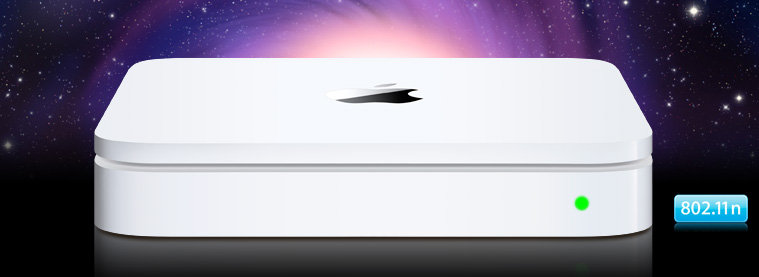
After a few months and independent from these issues, we decided to invest in a backup solution that was more comprehensive that the piece meal attempts at backup we were doing today. The consensus was to go with Apple's TimeCapsule as I had heard from others on how well it performed. For all intents and purposes it was identical to my current AP but with internal Hard Drive and Power supply so I was a bit trepidatious but gave it the green light. We purchased the product. Configured it in about 15 minutes and replaced the Simultaneous Dual-Band AirPort Extreme N Base Station and low and behold, all my problems went away! I was amazed and decided that 8 hours was not long enough for testing. 2 weeks later it is still going strong. I had found the weak link, or had I?

I repurposed the Slightly older AirPort to my boudoir/office and never had a problem again with either connections. To this day I am at a loss to explain it. Some combination caused the problem, once separated however, the problem disappeared.

You see, sometimes I get confused.


Tuesday, June 9, 2009

Disposable Income??

iFixit.jpeg

Well here we are, half way through 2009. This year saw the culmination of, arguably, the worst financial crisis since the Great Depression. Yada yada yada. We have heard this all before.


I thought we were going to talk about Wi-Fi?


Well today I thought I would talk about disposable computers. Several weeks ago an associate of mine saw her beloved 17 inch iMac G5 all-in-one start to shut down for no apparent reason. She had Apple Care and had no problem trucking it down to the local Apple Store Genius Bar for a looksie.


They had her Mac for a week and then called and said, "you better come down here". When she got there they broke it to her gently, her mac was dead. The logic board was failing and a replacement would cost more than the worth of the unit. A few tears were shed before she realized this would mean she would need a new iMac - STAT!


So she cam home with a new improved 20 inch, Aluminum Bezel, Glass front, 2.66GHz Intel Core 2 Duo iMac .


The poor old unit sat next to the front door accumulating dust until I stripped some parts off of it and sent the remainder to the recycling plant here in San Francisco where they are used to this kind of recycling, as I am sure they are elsewhere these days.


I felt bad. Seemed like a waste.


Then I did the worst thing a husband can do to a Wife's computer. I spilled a drink on my wife's MacBook. I freaked out, flipped the unit over, yanked out the mag-safe power cable and the battery and spent the next several hours wiping it down and blowing air through the unit to get it dry. I failed, the next morning she had a host of keyboard and restart issues. She was not happy, however, to her credit, she was not super mad at me either, just at the situation.


So, guess what I did? Yep. I took the unit down to the Apple Store, where again the Genius Bar Dude said it was covered by AppleCare and that they would call us in a few days and tell us what was up. And guess what the verdict was? 800 dollars, 100 dollars cheaper than the Brand New Macbook. Worth the investment? Probably not.


Now here is where most folks would start to rail against the new disposable society. Everything from cell phones to TVs are all disposable now. Right? Wrong.


Not me. Why? Well I have a small contribution to make to help stop this madness.


I found two places that were willing, with a little effort, to show me how to take care of these problems myself. No fancy Apple Store Genius, know-it-all, Fixer Upper, dude (BTW, most of the time, they do not even do their own repairs at Apple, they farm it out). It should be mentioned that I am no stranger to this kind of stuff. Awhile back I repaired my first original AirPort Basestation by replacing a burnt out capacitor. Heck, a logic board replacement for the MacBook doesn't even involve soldering


The first site I am sharing is run by a pair of guys who were in college and decided to try and fix their Mac themselves, then they were fixing their pals computers and then, weell, they said, You do it. They started iFixit. Ifixit will sell you the parts and show you how to replace them. This, of course, voids the warranty, but, hey, you were going to throw it out and get a new one anyway, right?


Here is their story in their words


It bugged us that most consumer devices lacked repair instructions. We think it should be easy for people to learn how to fix things.


So we wrote some instructions the first chance we got. And we posted them online, for free. For the first time, it was easy for someone with no technical background or experience to take apart a Mac. Our step-by-step instructions were enabling people to repair Macs they wouldn't have been able to repair on their own.


We thought the instructions would be useful to our customers -- and they were. But it turned out that they were useful to a lot of other people as well! We've heard repair success stories from forensic detectives, field translators, and even kids. From New York to Alaska, Tibet to the Faroe Islands, people have used our guides to fix their stuff. They saved money, they kept their Macs out of the landfill, and they did it completely by themselves.


And the amazing thing? They enjoyed doing it. It's fun to take stuff apart. It's interesting to see what's inside that magic iPod you carry around every day. It's gratifying to fix it with your own hands. Don't believe us? Try it! Fix your Mac yourself. Show a friend how to fix something.


We're all in this thing together, and if we work together we can fix the planet. Join us.

Neat! And they are helping the environment while making a good buck or two in the process. Oh, and not just Macs, Nintendos, Palm Pre's, iPones and iPods, and even bananas


Next up, I found there guys, The Powerbook Medic folks. Theyare similar to iFixit in that they sell parts and show you how to fix stuff. They also will fix it for you (for a reasonable fee) and they also have video tutorials on YouTube


youtubelogo.jpeg

Lastly, they have made their own Mac Tablet PC from an old MacBook - it looks pretty sweet


MacTablet.jpg


The total cost to fix my Wife's Macbook now looks to be around $250-$350. A far cry from the $800 plus I was quoted to do the same thing by the Apple Store. Don't get me wrong, AppleCare is awesome. It has saved my bottom so many times. Well worth every penny, but aside from that, do we really need to be tossing out so many electronics in this day and age?


So it turns out you do not have to chuck out that pretty awesome Apple MacBook after all. I am sure there are sites for Dell, Toshiba, Gateway, Sony and homegrown BYO (build it yourself) FrankenPuters and others as well. A quick google search shows you that anyone can do this kind of repair.


Oh, now, how I wished I could go back and get that iMac G5.


UPDATE!

We finally got the MacBook back from Apple and now it will not boot. It booted before, just had crazy keyboard shenanigans. Now, Dead.


So now we have to move forward with the plan. I will update as I do it.

Thursday, November 1, 2007

WiFi Enabled Bag!

OK, Admission. The previously lauded WiFi enabled Shirt SUCKED! It had this big plasticky velcro'y patch on the front. I just couldn't wear it. I thought it would be more integrated. So...

My wife the genius (BTW, she is a geek, too. She really wanted me to order her one. So I did). She takes one look at her shirt and says, " I am not going to wear this but I have an idea."


She tears the shirt apart and buys herself a new bag/backpack/purse. She cuts a hole in the front of the bag for the cable. Sews the felt backing used to secure the velcro to the front of the bag. Puts the battery pack and cable into an internal pocket and away we go. WiFi enabled bag!!!

This is way more cool than the lame shirt. Now she carries this to work proudly, letting all around her know if they can surf via WiFi or not.

Friday, October 5, 2007

WiFi enabled shirt?!!!

As if some geeky clothing designer and an Uber-RF-Nerd had a dorky lovechild, ThinkGeek has launched the first WiFi enabled SHIRT!!!


I am not kidding. this a a wearable WiFi detector that illustrates the strength of the WiFi signal with glowing bars and antenna and the words, "802.11" underneath.


I cannot wait to wear this to the next, "I can't get a date with nobody/Star Trek/D&D/comic book/video game/networking convention"


Look, Drool and count the days till it is released.


Tuesday, April 10, 2007

WiFi on the highway: Avis to offer 3G-to-802.11 bridge

Start-up Autonet Mobile and car rental giant Avis are partnering to offer renters a device that will provide laptop users with WiFi access on the road. You can take "on the road" literally in this case, as the device is designed to create a WiFi hot spot accessible from within


read more | digg story


So I am driving down the road. I have my Bluetooth headset "un-wired" to my Blackberry (I know, I should've gotten a Pearl but I am waiting on the iPhone). I am receiving email on that same Blackberry and answering it, of course. I have my iPod plugged into cigarette lighter and tape player with an adapter and I am selecting music to accompany my travels and sometimes watching the strange conclusion to Battlestar Galactica season 3.5 (Damn! next episode is in 2008). I have a GPS talking to me and showing me where to go for my next appointment at the latest geek-fest. And now I have a rolling 3G/WiFi hotspot allowing me complete access to the web so I can blog about the experience. Of course my Homies are riding shotgun so we start up a LAN party and start blowing each other away in CounterStrike. Wooooeeee! Maybe we should play Full Auto(tm) 2: Battlelines?


Man, I am in sensory overload and I haven't even looked up to see where I am going yet.